Why Designers Should Brief Themselves
Most designers' portfolios are shaped by accident, not intent.
You take the work that comes. A few church projects in a row and suddenly you're "the church designer." Three CPG packaging projects and clients start finding you for CPG. A medical client refers a friend in healthcare and the next thing you know, half your inbound is healthcare.
The portfolio writes the future. And the future you didn't choose starts choosing you.
This is one of the quiet traps of an early or mid-career design practice. You build a body of work that reflects which clients happened to find you — not what you actually want to make. And the longer you go without correcting it, the harder it becomes to break out, because every new client googles you, sees the existing pattern, and assumes that's the work you do.
There's a way out, and it's been sitting in plain sight the whole time.
Designers Are the Only Creative Discipline That Treats Personal Work as Suspect
Painters paint without commissions. Writers draft novels with no contract in sight. Filmmakers make shorts on weekends. Musicians write songs no one asked for.
Photographers shoot personal series for years before anyone pays them for it.
In every other creative discipline, personal work isn't filler. It's the foundation of the practice. It's where the artist figures out what they actually care about, separate from what anyone is paying them to care about.
Design is the one field where "personal work" gets treated as suspect. As if a designer making something on their own time is admitting they don't have real clients. As if the only legitimate design is design that arrives with a brief from someone else.
That framing is wrong. And it costs designers their range.
Spec Work and Self-Initiated Work Are Not the Same Thing
The reason design culture is allergic to personal work is that "spec work" has a bad reputation, and rightly so. Pitching a client for free, undercutting paid designers, doing real client work without a contract — that's a problem. It devalues the field.
But self-initiated work is a different category entirely. It isn't pitched. It isn't for a real client. It isn't an attempt to get paid retroactively. It's a designer choosing to make something they want to make, with no one's expectations to meet but their own. It's a brief written by the designer, for the designer, about a problem the designer wanted to think about.
That isn't unprofessional. That's how every other creative discipline operates by default.
Why It Matters Strategically
A portfolio built only from client work shows what a designer has been hired to do. A portfolio that includes self-initiated work shows what a designer wants to do.
Those are two different signals, and the second one is the one that breaks the loop. It tells the next client — and the next agency, the next collaborator — that the designer has a point of view, not just a track record. That they're thinking about where the work is going, not just where it's been.
A typecast portfolio is a closed system. Every new project reinforces the pattern. Self-initiated work opens that system back up.
What Self-Initiated Work Isn't
It isn't a Dribbble shot. It isn't a 30-second concept sketched between client revisions. It isn't generative output reframed as personal exploration.
The bar should be the same as any real client project: real strategy, real craft, real systems thinking, real time invested. The only thing missing is the client. Everything else — the rigor, the iterations, the deliverables — should be the same as work that's billed.
If anything, self-initiated work should be harder, not easier, because the designer is the only person on the project. There's no client steering, no committee softening edges, no compromise to land on something everyone can agree to. The designer has to make every decision and justify every decision to themselves. That's where the real growth happens.
What I Made: Hotel Olivette
Recently I designed a brand for a hotel that doesn't exist.
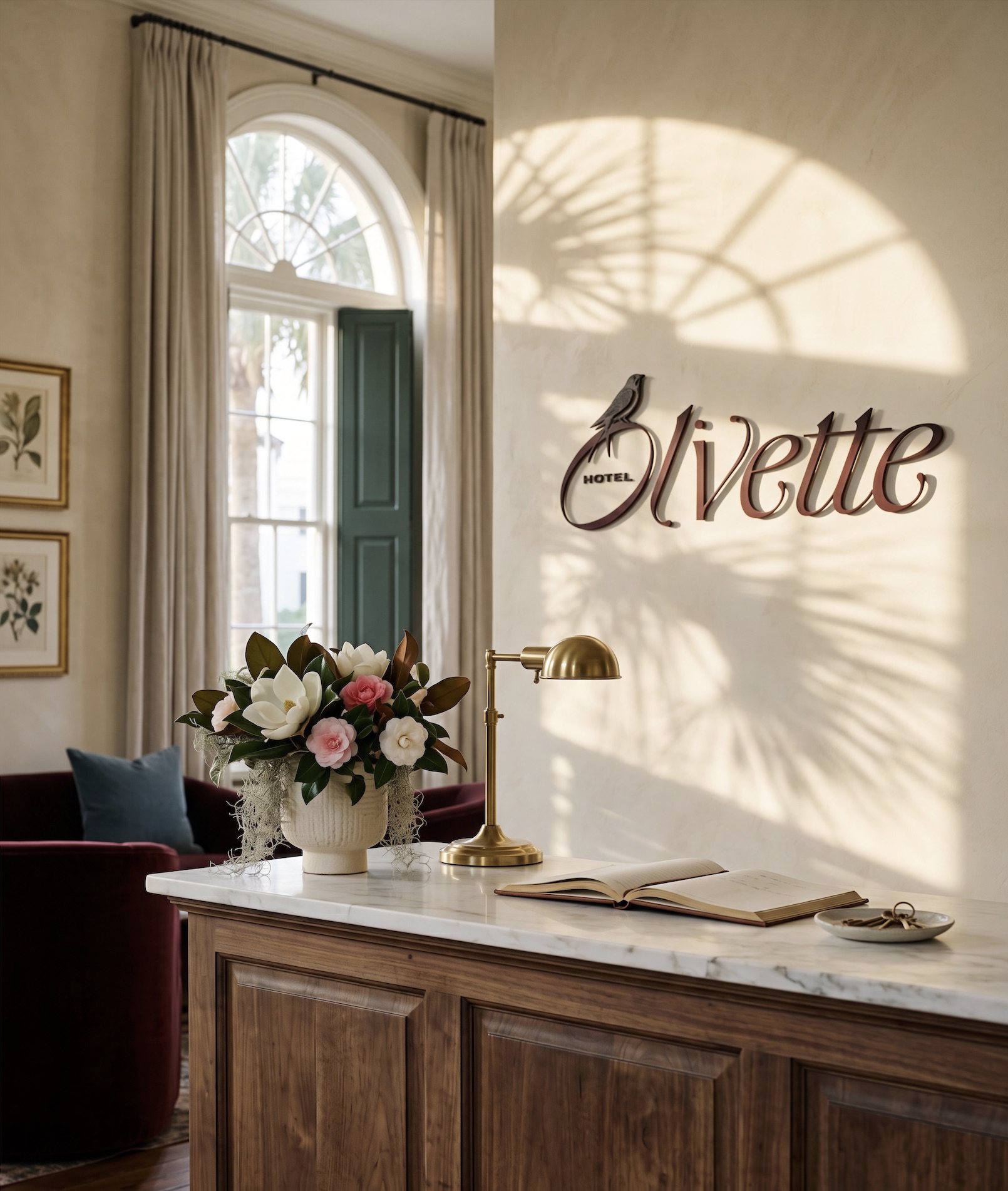
Hotel Olivette is a concept for a small luxury hotel sited on The Battery — the southernmost edge of Charleston's historic district, where antebellum mansions face the seawall and the harbor light turns the city pink at sunset. I wanted to work on a hospitality project before I had one in front of me, and instead of waiting for the right brief to come through, I wrote my own.
The brief I gave myself was simple: build an identity that belongs to The Battery specifically. Not Charleston in general. Not coastal luxury as a category. The Battery — its light, its birds, its harbor, its quiet.
The wordmark is a custom italic script that references the typographic vernacular of historic Charleston signage. A swallow perches on the ascender of the O, drawn from the maritime tradition of sailors getting swallow tattoos to mark a safe return home. For a port city hotel, the symbolism does double work: a hotel is a place of return, and Charleston's identity is inseparable from the sea.
The pattern system is a hand-drawn wave-and-cloud motif in dusty harbor blue on warm cream — the way sky and water blur into a single tone on humid Battery mornings. The palette pairs oxblood and navy across the day, oxblood for evening and navy for morning, the brand shifting with the rhythm of the guest's experience.
It's a fully resolved brand for a hotel that has no clients, no investors, no opening date. It exists because I wanted it to exist.
The Principle
Designers should brief themselves more. Not because client work isn't enough — but because the parts of a designer's range that haven't been hired yet still need somewhere to live. The portfolio shouldn't be only a record of the past. It should also be a map of where the designer is going.
The next client doesn't just hire your résumé. They hire your direction. And the direction has to be visible somewhere.
Self-initiated work is where it lives.
Every creative discipline takes its personal work seriously. Design should too.
——
Tucker Oelsen is a brand and web designer based in Austin, Texas, working with hospitality, luxury living, and lifestyle brands. Hotel Olivette is part of an ongoing series of self-initiated brand projects.